
Conversion Lift Calculator
Measure the true business impact of your A/B tests and marketing changes. Enter your Control and Treatment metrics below to instantly calculate the percentage lift and see if your new variant actually improved performance.
+0%
- Input your baseline and variant conversion rates.
- Positive lift means your change improved performance.
How Conversion Lift is Calculated
Conversion lift is the percentage difference between your new variant (treatment) and your original version (control). It measures relative change, not absolute change, telling you exactly how much better or worse your experiment performed.
The Formula
Example Calculation
- Control (Original) Rate: 3.00%
- Treatment (New Variant) Rate: 5.00%
Interpreting Lift Results
A positive lift number is the goal of any A/B test, but context matters. A large lift on a tiny sample size might not be reliable, while a small lift on millions of users could be worth millions in revenue.
| Lift Percentage | Interpretation & Action |
|---|---|
| Negative Lift (< 0%) | The treatment underperformed. Revert to the control version. |
| 0% to +5% | Minor improvement. Ensure statistical significance before rolling out. |
| +5% to +20% | Solid win. A clear indicator that your optimization strategy is working. |
| Above +20% | Massive impact! Double-check your data validity. If accurate, deploy immediately. |
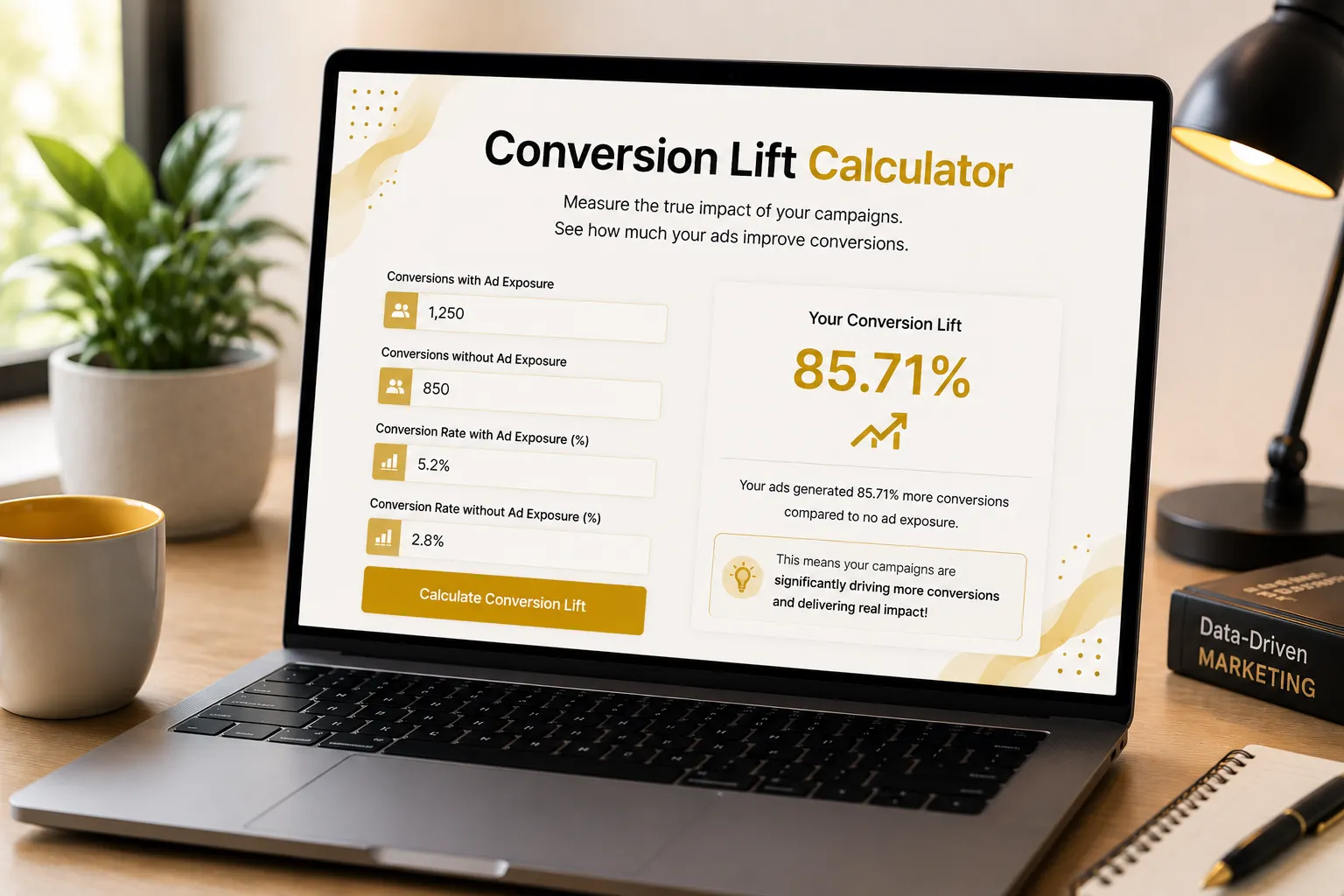
How to Use the Conversion Lift Calculator
Enter Control Rate
Input the conversion rate of your original baseline (e.g., your current landing page or existing ad campaign).
Enter Treatment Rate
Input the conversion rate of your new variant, challenger, or test group.
Analyze the Lift
Instantly see the relative percentage difference to determine if your marketing change caused a positive impact.
Mastering Your Experimentation Strategy
In the world of A/B testing and Conversion Rate Optimization (CRO), "Lift" is simply a way of asking: "How much better (or worse) did our new change perform compared to the original?" Calculating Conversion Lift helps marketers isolate the incremental impact of their campaigns, website tweaks, or ad copy changes. Instead of guessing if a change worked, you can mathematically prove the relative difference.
One of the most common mistakes marketers make is confusing absolute difference with relative lift. If your control group converts at 1% and your new treatment group converts at 2%, the absolute difference is only 1 percentage point. However, the Conversion Lift is a massive 100% because you have successfully doubled your performance. Understanding this distinction is vital for accurately reporting on the value of your experimentation programs.
While calculating the lift percentage is straightforward, making business decisions requires pairing lift with statistical significance. A massive +200% lift is meaningless if it is based on only 5 visitors. On the flip side, a modest +5% lift proven across millions of visitors can translate to millions of dollars in incremental revenue. Always use a tool to calculate your lift, and then use a significance calculator to ensure those results didn't happen by random chance.
Frequently Asked Questions (Conversion Lift)
1. What is Conversion Lift?
2. How do I calculate Conversion Lift?
3. What does a negative Conversion Lift mean?
4. Is Conversion Lift the same as Statistical Significance?
5. What is considered a "good" Conversion Lift?
6. How long should I run a test to measure lift?
7. What is "incremental revenue" in relation to lift?
8. Can I measure Conversion Lift for offline sales?
9. Why is measuring relative lift better than absolute difference?
10. Does Conversion Lift account for seasonality?
More PPC Calculators
Client Success Stories & Reviews
"KashifDigitals completely transformed how we measure our A/B tests. By accurately calculating our Conversion Lift, we now only scale changes that genuinely improve our bottom line!"
"The focus on monitoring true relative lift rather than just blind percentage point drops changed our whole approach. We are now optimizing our site with total confidence."
"Simple, effective, and eye-opening. Tracking our Conversion Lift this closely helped us prove ROI on our recent landing page redesign. Highly recommended tool."
"I am not a math person, so calculating relative differences for experiments used to give me a headache. This Conversion Lift calculator is an absolute lifesaver. Fast and simple!"
"I've been using this tool for my client reporting and onboarding. It's incredibly straightforward to show them exactly how much our CRO work has improved their store."
"Such a handy widget! I keep this bookmarked and use it almost daily when checking my ongoing experiment variants against the control groups. It genuinely helps me plan."
"Honestly, this is the quickest way to check my overall test results. I don't have to navigate through cluttered dashboard analytics just to do a quick lift check."
"We run a high-ticket service business. This calculator is stupid-simple to use and helps me make sure my new lead forms are actually generating better engagement."
"A perfectly executed tool. Clean interface, instantly updates, and zero annoying popups. Exactly what I look for in free digital marketing resources."
Need a Specific Tool? Or Found a Bug?
Our dev team is actively updating this page with useful new calculators. If you have an idea for a business tool or want to report a calculation error, please let us know.
Submit Request / Report Bug